You've got a solid content strategy, a knack for identifying underserved niches, and the drive to build something scalable. The bottleneck? Video production. Creating engaging YouTube content, especially for educational or narrative channels, is a time sink. Scripting, voiceovers, finding visuals, editing – it’s a full-stack job for every single video. For senior developers accustomed to automating everything else, this manual process feels like a step backward. We're constantly looking for leverage. Tools that amplify our output without compromising quality. We want to focus on the strategic decisions, the content ideas, and the channel growth, not the pixel-pushing. This is where platforms promising automated YouTube storytelling become interesting. Today, I want to talk about one such platform, PilotPrograme.com, and explore its potential for building efficient, faceless YouTube automation channels, particularly within a fascinating niche: African folktales. No, this isn't another generic AI content generator. PilotPrograme carves out a specific niche, and its approach warrants a closer look, especially for those of us who appreciate a focused tool designed to solve a particular problem.
The Content Generation Problem: Beyond Manual Labor
Think about the typical workflow for a narrative YouTube channel:
- Idea Generation: Brainstorming topics, stories, angles.
- Scriptwriting: Crafting compelling narratives, fact-checking.
- Voiceover Recording: Professional narration, clear audio.
- Visual Sourcing: Finding relevant stock footage, images, or creating animations.
- Editing: Syncing audio and video, adding text overlays, music, transitions.
- SEO & Publishing: Titles, descriptions, tags, thumbnails.
Each step demands specific skills and significant time. If you're building a channel that requires a high volume of content – say, daily or bi-weekly uploads – this quickly becomes unsustainable without a dedicated team. For a solo operator or a small team, scaling is a pipe dream. This is the core problem automated YouTube storytelling platforms aim to address. They promise to streamline, if not outright eliminate, several of these manual steps.
PilotPrograme: An Overview of Automated YouTube Storytelling
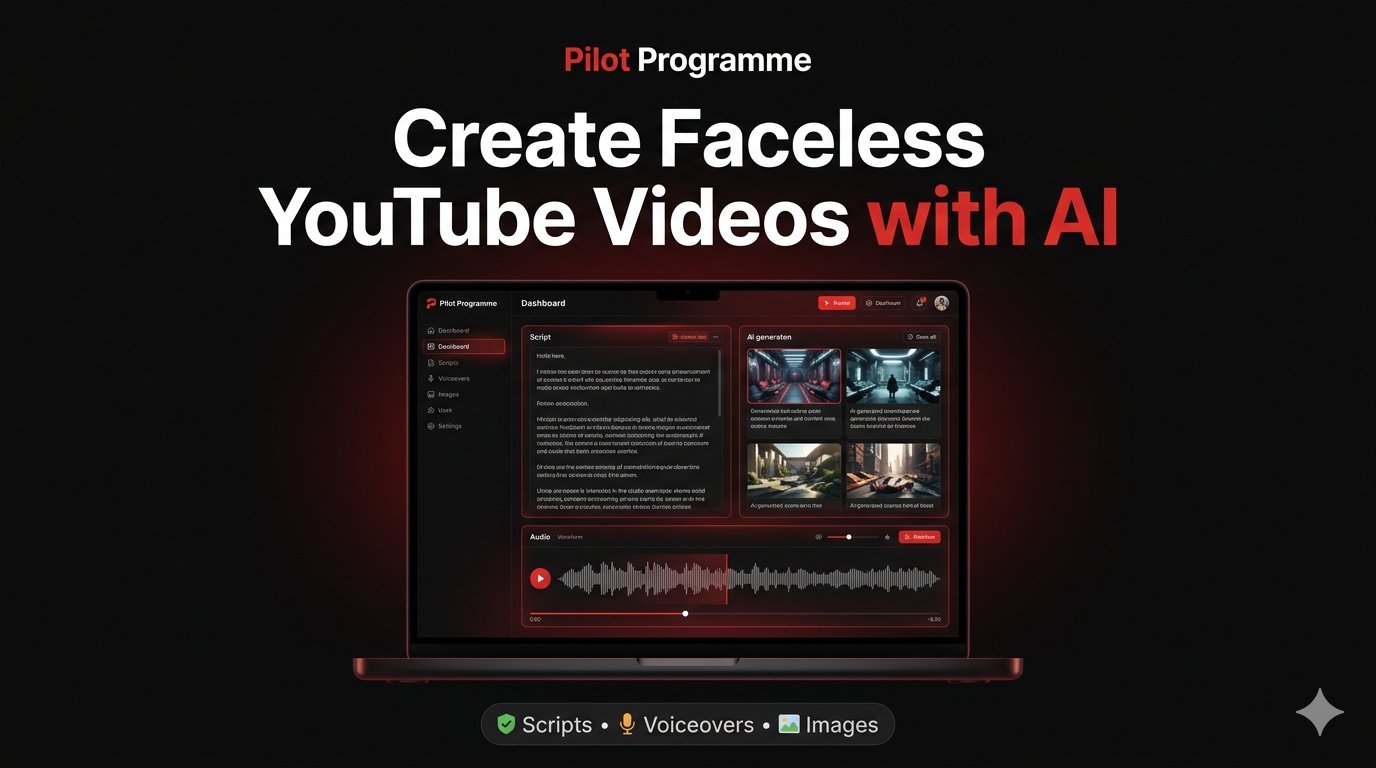
PilotPrograme.com positions itself as an AI-powered platform for YouTube automation and storytelling. The premise is straightforward: provide a concept or a prompt, and the platform handles script generation, voiceover, and video creation. This immediately speaks to the "generate automated YouTube storytelling" keyword. Upon reviewing the site, several key functionalities stand out:
- AI Storyteller: Generates video scripts from user prompts. This is the foundation, translating an idea into a narrative structure.
- AI Voiceover: Converts the generated script into natural-sounding speech. This eliminates the need for manual recording or hiring voice actors for every video.
- AI Video Generator: Assembles visuals, background music, and text overlays to create a complete video from the script and voiceover. This is where the "faceless YouTube automation" aspect truly comes alive.
The platform's stated goal is to enable users to "create engaging YouTube videos in minutes, without any editing skills." For us, "without any editing skills" translates to "minimal manual intervention," which is exactly what we're after for automation.
The African Folktales Angle: A Niche Goldmine
What truly differentiates PilotPrograme.com from more generic YouTube automation platforms is its explicit focus on African folktales. The site prominently features "Generate engaging YouTube videos from African folktales." This is a significant differentiator. Why is this important? 1. Underserved Niche: While there are channels dedicated to global mythology or specific cultural stories, a high-quality, consistently updated channel focused solely on African folktales is less common. This represents a substantial opportunity for early movers. 2. Rich Content Pool: Africa boasts an incredibly diverse and deep reservoir of oral traditions, myths, legends, and moral tales. This provides an almost endless source of unique, engaging content that resonates with a global audience interested in culture, history, and storytelling. 3. Educational Value: Such content offers significant educational value, appealing to audiences interested in learning about different cultures, history, and moral lessons embedded in these stories. This can translate to higher audience retention and engagement. 4. SEO Advantage: Targeting specific, less saturated keywords related to "African folktales," "Yoruba legends," "Zulu myths," etc., can provide a competitive edge in search rankings compared to broader, more competitive terms. For developers looking to build a sustainable content engine, identifying and dominating such a niche is a classic strategy. PilotPrograme provides a tool specifically tailored to exploit this.
How "Faceless" Automation Works Here
The term "faceless YouTube automation" refers to channels that produce video content without a visible human presenter. This model is popular for several reasons:
- Scalability: You don't need to be on camera, reducing production overhead significantly.
- Privacy: Ideal for creators who prefer anonymity.
- Focus on Content: The emphasis remains entirely on the story or information being conveyed, not the personality of the presenter.
- Cost-Effective: Eliminates the need for studio setups, professional lighting, or on-screen talent.
PilotPrograme fits this model perfectly. By automating script generation, voiceover, and visual assembly, it creates videos that rely on AI-generated elements rather than human performance. The visuals are typically stock footage, animated graphics, or static images that illustrate the narrative. The voice is an AI-generated voice. The end product is a complete, narrative-driven video ready for upload, without a face ever appearing on screen.
Architectural Deep Dive: How It (Likely) Works Under the Hood
For senior developers, understanding the "how" is often as important as the "what." While PilotPrograme doesn't provide explicit architectural details, we can infer the underlying technologies and processes based on its stated functionalities. This is a common pattern for many YouTube automation platforms.
AI Storyteller: NLP & Generative Models
The core of any automated storytelling platform is its ability to generate coherent and engaging narratives. This relies heavily on advancements in Natural Language Processing (NLP) and large generative AI models. 1. Prompt Engineering: The user provides a prompt (e.g., "Generate a story about Anansi the Spider and the Sky God" or "Tell a cautionary tale from the Hausa tradition"). This prompt is the initial input. 2. Contextual Understanding: The AI model, likely a fine-tuned version of a transformer-based model (like GPT-3.5 or GPT-4), interprets the prompt. It needs to understand the entities (Anansi, Sky God), the desired genre (folktale), and potentially cultural nuances if it's specifically trained on such datasets. 3. Narrative Generation: The model then generates a script, typically following a story arc:
- Introduction: Setting the scene, introducing characters.
- Rising Action: Developing the plot, introducing conflict.
- Climax: The peak of the story.
- Falling Action: Resolution of conflict.
- Resolution/Moral: Concluding the story, often with a lesson.
For African folktales, this might involve accessing a vast corpus of such stories during its training phase, allowing it to mimic the style, common tropes, and moral structures inherent in those traditions. 4. Script Refinement: Post-generation, there might be internal algorithms for checking coherence, readability, and adherence to a specified length or tone. Users might also have options to refine the script manually. The quality of the generated script is paramount. A weak script leads to a weak video, regardless of the subsequent steps.
AI Voiceover: Text-to-Speech (TTS) Engines
Once a script is generated, it needs to be narrated. This is handled by sophisticated Text-to-Speech (TTS) engines. 1. Text Input: The generated script is fed into the TTS engine. 2. Phoneme Conversion: The engine breaks down the text into phonemes (the basic units of sound in a language). 3. Prosody Generation: This is where the "natural-sounding" aspect comes in. The engine adds elements like pitch, rhythm, emphasis, and intonation to make the speech sound human-like rather than robotic. Advanced TTS models use deep learning to synthesize speech that captures emotional nuances. 4. Voice Selection: PilotPrograme likely offers a selection of voices (male/female, different accents) for users to choose from, allowing for some customization. The quality of these voices has improved dramatically in recent years, making them highly suitable for faceless content. 5. Audio Output: The final output is an audio file (e.g., MP3, WAV) of the narrated script.
AI Video Generator: Asset Management & Composition
This is arguably the most complex part of the YouTube automation pipeline, as it involves visual composition. 1. Visual Asset Library: PilotPrograme must maintain a vast library of stock footage, images, animated graphics, and background music. These assets are typically categorized and tagged for easy retrieval based on keywords from the script. 2. Script Analysis for Visual Cues: The AI analyzes the script to identify key themes, objects, actions, and emotions. For example, if the script mentions "a wise old tortoise," the AI searches its library for images or footage of tortoises, or perhaps a visual metaphor for wisdom. If it mentions "a bustling market," it looks for relevant city or market scenes. 3. Scene Segmentation: The script is broken down into logical segments or "scenes" based on changes in topic, character, or action. 4. Asset Matching & Placement: For each segment, the AI selects appropriate visual assets from its library. It then places these assets in a timeline, syncing them with the corresponding voiceover segments. 5. Text Overlays & Captions: The system likely adds on-screen text, either as titles, key points, or full captions (subtitles), which are crucial for accessibility and viewer engagement, especially for faceless content. 6. Background Music: Appropriate royalty-free background music is selected and added, often with dynamic volume adjustments to ensure the voiceover remains clear. 7. Transitions & Effects: Basic video transitions (cuts, fades) and perhaps some subtle effects are applied to create a smooth viewing experience. 8. Rendering: Finally, all these elements are composited and rendered into a complete video file (e.g., MP4) in a suitable resolution (e.g., 1080p). This process can be computationally intensive, often leveraging cloud-based GPU instances.
The Automation Pipeline: Orchestration
The real "automation" isn't just about individual AI components; it's about orchestrating them into a seamless workflow. This involves: 1. Workflow Engine: A backend system that manages the flow from prompt to final video. This could be a series of microservices or a monolithic application. 2. Task Queues: Given the resource-intensive nature of AI processing and video rendering, tasks are likely queued and processed asynchronously. 3. Error Handling & Retries: Robust systems include mechanisms to handle failures at any stage and retry operations. 4. User Interface: A web-based UI provides the front-end for users to input prompts, review outputs, and manage their projects. This entire pipeline, from idea to ready-to-upload video, is what constitutes the "YouTube automation platforms" category. PilotPrograme's value proposition is in streamlining this complex sequence, especially for its niche.
Getting Started: A Developer's Workflow with PilotPrograme
Let's consider how a senior developer might approach PilotPrograme, not just as a casual user, but as someone looking to integrate it into a broader content strategy or even automate the use of the platform itself (if an API were available, which is a common developer desire).
Sign up now: https://pilotprograme.com
Account Setup and Initial Project
The first step is straightforward: register on PilotPrograme.com. The site indicates a free tier, which is excellent for initial experimentation. This allows you to test the waters without commitment, addressing the "free YouTube automation platform" keyword directly. The free tier typically comes with limitations on video length, number of generations, or access to premium voices/visuals. This is standard for SaaS platforms. Once registered, you'd likely create a new project. For our African folktales channel, this might be named "Tales of the Baobab Tree" or "African Wisdom Narratives."
Script Generation Walkthrough
The core interaction begins with generating a script. The platform would present an input field for your prompt. Let's imagine a conceptual Python script that could feed prompts to such a platform if it had an API. Even without a direct API, this illustrates the structured thinking a developer brings to content generation.
In the actual PilotPrograme web interface, you'd simply type your prompt and click "Generate." The platform then processes this, returning a script. You'd review this script, making any necessary edits to ensure accuracy, tone, and cultural sensitivity. This human oversight is crucial, as AI, while powerful, can sometimes generate factual inaccuracies or lack the nuanced understanding of complex cultural narratives.
Video Generation and Export
Once the script is satisfactory, the next step is to generate the video. This involves:
- Voice Selection: Choosing an AI voice that fits the narrative style.
- Visual Theme/Style: Some platforms offer options for visual themes (e.g., animated, realistic stock footage, static images). PilotPrograme likely selects visuals based on script analysis.
- Background Music: Selecting from a library of royalty-free tracks. After these selections (or if the platform auto-selects based on defaults), you initiate the video generation. This is typically the most time-consuming step, as it involves rendering. The platform would provide a progress indicator, and once complete, you'd be able to preview the video. A conceptual shell script to manage video rendering and download might look like this, assuming an API and a CLI tool:
After reviewing the generated video, you'd typically download the final MP4 file. This file is then ready for upload to YouTube, where you'd add your custom thumbnail, optimize the title and description, and add relevant tags.
PilotPrograme in the Broader YouTube Automation Landscape
PilotPrograme is one of many platforms emerging in the YouTube automation space. However, its specific focus on African folktales and comprehensive AI-driven workflow sets it apart.
Comparison Table: PilotPrograme vs. Manual Production vs. Generic AI Tools
To frame its value, let's compare PilotPrograme to traditional manual production and a hypothetical generic AI video generator that lacks its niche focus.
| Feature/Aspect | Manual Production (Traditional) | Generic AI Video Generator (No Niche) | PilotPrograme.com (Niche-Focused AI) |
|---|---|---|---|
| Script Generation | Human writer (high effort, high cost) | AI-driven (variable quality, broad topics) | AI-driven (focused on storytelling, strong for African folktales) |
| Voiceover | Human narrator/actor (high effort, high cost) | AI TTS (variable quality, generic voices) | AI TTS (improving quality, likely diverse voice options) |
| Visuals Sourcing | Manual search, licensing, custom creation (high effort) | AI-driven stock library (broad, may lack specific cultural context) | AI-driven stock library (potentially curated for cultural relevance, e.g., African themes) |
| Video Editing | Human editor (high skill, high effort, high cost) | Automated (basic cuts, transitions) | Automated (seamless integration of script, voice, visuals) |
| Niche Focus | Whatever the creator chooses (requires manual research) | Broad, generic content (hard to stand out) | Strong, explicit focus on African folktales (competitive advantage) |
| Time to Produce 5-min Video | Hours to days | Minutes to an hour (with review) | Minutes to an hour (with review) |
| Cost per Video | High (labor, software, assets) | Subscription + credits (variable) | Subscription + credits (competitive, free tier available) |
| Scalability | Low (limited by human resources) | Moderate to High (depends on AI quality/volume) | High (leveraging niche + automation) |
| Cultural Nuance | High (if creator is knowledgeable) | Low to moderate (generic AI) | Potentially higher due to specific training/focus on folktales |
This comparison highlights PilotPrograme's strength: it combines the efficiency of AI automation with a specific content niche, which can lead to more focused and potentially higher-quality output within that domain.
Cost-Benefit Analysis: Is "Free" Really Free?
PilotPrograme offers a free tier. For senior developers evaluating "free YouTube automation platforms," it's essential to understand the typical limitations:
- Video Length: Free plans often cap videos at 1-2 minutes. This is enough for short explainers or teasers but not for full storytelling.
- Monthly Credits/Generations: You might get a limited number of script generations or video renders per month.
- Feature Access: Premium voices, higher resolution video, access to a broader asset library, or faster rendering might be locked behind paid tiers.
- Watermarks: Some free tiers include watermarks on generated videos.
So, while PilotPrograme *is* a free YouTube automation platform in its base offering, serious content creators aiming for monetization and scale will inevitably need to upgrade to a paid plan. The free tier serves as an excellent proof-of-concept and testing ground. For our African folktales channel, a paid tier would be necessary to produce longer, more detailed narratives and ensure high production quality.
Use Cases and Advanced Strategies for Developers
Beyond simply generating videos, senior developers can leverage a platform like PilotPrograme in more sophisticated ways.
Scaling Content Production
The most obvious use case is scaling. Imagine you're building a network of niche channels. One for African folktales, another for historical anecdotes, perhaps a third for scientific explainers. Manually managing this would be impossible. With PilotPrograme, you can: * Batch Processing: Prepare a list of 50 folktale prompts. If the platform offers an API (or you can simulate interactions programmatically), you could queue up these generations. * Content Calendars: Integrate the platform's output into your content calendar automation tools (e.g., a Python script that uploads to YouTube via its API, schedules posts, and updates a Google Sheet). * A/B Testing: Generate multiple versions of titles, descriptions, or even short video intros/outros to A/B test audience engagement.
Niche Channel Development
The African folktales focus is a powerful example of niche development. Developers can think even more granularly: * Regional Focus: A channel dedicated solely to West African proverbs, or Southern African myths. * Specific Themes: Channels focusing on animal fables, creation myths, or tales of heroes from specific traditions. * Language Integration: If PilotPrograme supports multiple languages, creating channels in indigenous African languages could open up entirely new, less competitive markets. The goal is to build authority and a dedicated audience within a very specific segment, making your channel the go-to resource for that content.