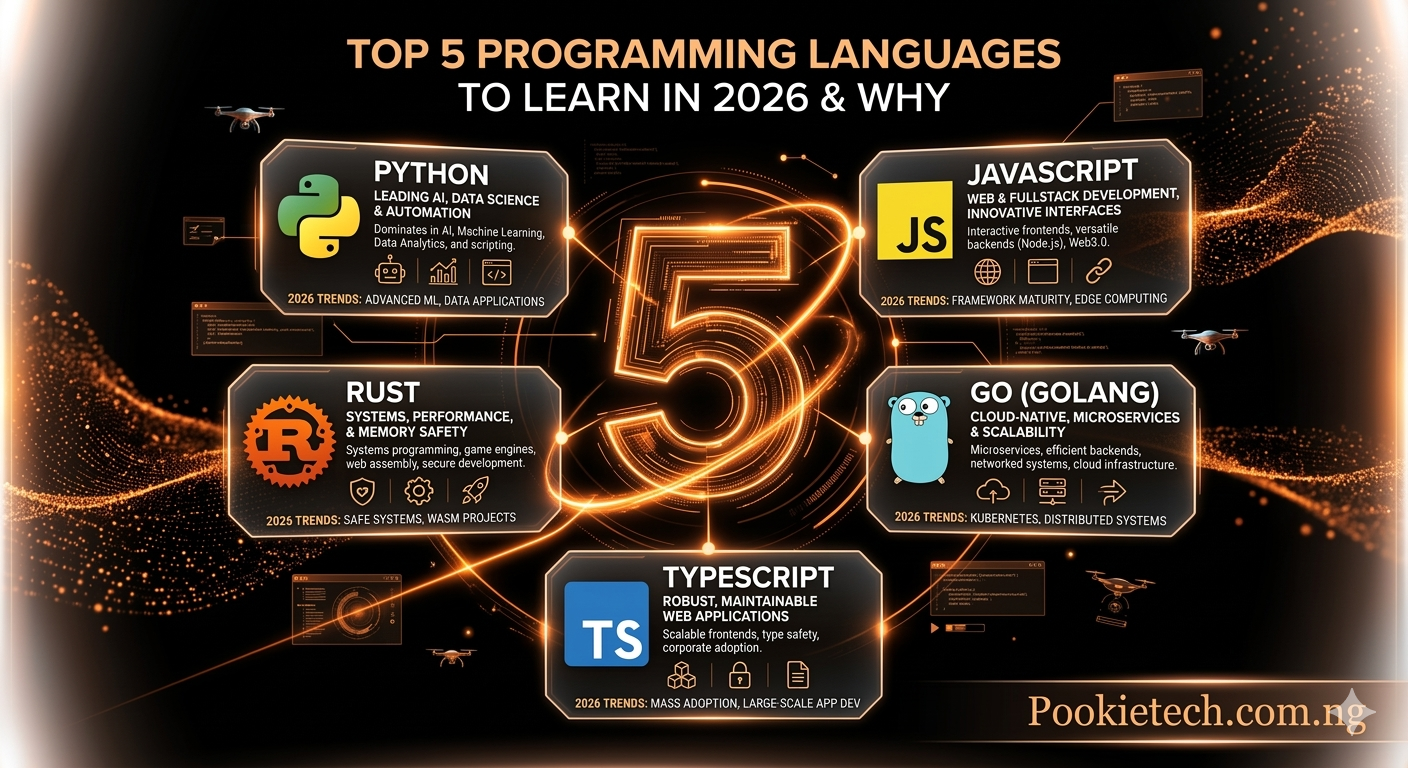
Top 5 Programming Languages to Learn in 2026 & Why
The tech landscape shifts fast. What was cutting-edge last year might be legacy next. As an intermediate developer, staying relevant means constantly evaluating your toolkit. Betting on the wrong language now could mean scrambling to catch up in 2026. This isn't about chasing hype; it's about understanding where the industry is heading and equipping yourself with the right tools for the jobs that will matter.
We've analyzed market trends, job postings, ecosystem growth, and critical technology shifts to identify the programming languages that will offer the most significant opportunities and impact for developers by 2026. This isn't a definitive list for every niche, but these five languages provide a robust foundation for diverse, high-demand roles.
1. Python: The AI/ML & Data Powerhouse
Why Python for 2026?
Python's dominance in Artificial Intelligence, Machine Learning, and Data Science continues to accelerate. With the rapid evolution of generative AI, large language models, and advanced data analytics, Python's extensive libraries and frameworks (TensorFlow, PyTorch, scikit-learn, Pandas) make it the de facto standard. Beyond AI/ML, its versatility in web development (Django, FastAPI), automation, and scripting ensures its omnipresence. Expect its ecosystem to grow even more robust as AI applications become integral to every industry.
Key Strengths
- Unrivaled AI/ML Ecosystem: The sheer volume and quality of libraries for data manipulation, machine learning, and deep learning are unmatched.
- Readability & Productivity: Its clear syntax allows for faster development cycles and easier collaboration.
- Versatility: From web backends to data pipelines, automation scripts, and scientific computing, Python covers a vast array of applications.
- Large Community & Resources: Extensive documentation, tutorials, and community support.
Practical Use Cases
- Building and deploying machine learning models (e.g., recommendation systems, predictive analytics).
- Developing data-intensive web applications and APIs.
- Automating infrastructure tasks and cloud deployments.
- Creating data processing and ETL pipelines.
Considerations
Python's Global Interpreter Lock (GIL) can limit true multi-threading performance for CPU-bound tasks, though asynchronous programming (asyncio) and multi-processing mitigate this. For high-performance, low-latency systems programming, other languages might be more suitable. However, for the majority of AI/ML and data workloads, Python remains the top choice.
Code Example: Asynchronous Web Scraper for AI Data Prep
This example demonstrates an asynchronous web scraper using asyncio and httpx to efficiently fetch data, which is a common task in preparing datasets for AI/ML models. It uses BeautifulSoup for parsing.
import asyncio
import httpx
from bs4 import BeautifulSoup
from typing import List, Dict

async def fetch_page(client: httpx.AsyncClient, url: str) -> str:
    """Fetches content from a given URL asynchronously."""
    try:
        response = await client.get(url, timeout=10.0)
        response.raise_for_status() # Raise an exception for HTTP errors
        print(f"Successfully fetched: {url}")
        return response.text
    except httpx.HTTPStatusError as e:
        print(f"HTTP error for {url}: {e.response.status_code} - {e.response.text}")
        return ""
    except httpx.RequestError as e:
        print(f"Request error for {url}: {e}")
        return ""

def parse_product_data(html_content: str) -> List[Dict[str, str]]:
    """Parses product data from HTML content."""
    if not html_content:
        return []
    soup = BeautifulSoup(html_content, 'html.parser')
    products = []
    # This is a simplified example; adjust selectors based on actual website structure
    product_cards = soup.find_all('div', class_='product-card')
    for card in product_cards:
        title_tag = card.find('h3', class_='product-title')
        price_tag = card.find('span', class_='product-price')

        title = title_tag.get_text(strip=True) if title_tag else 'N/A'
        price = price_tag.get_text(strip=True) if price_tag else 'N/A'

        products.append({'title': title, 'price': price})
    return products

async def main():
    urls = [
        "http://quotes.toscrape.com/", # A public site for scraping examples
        "http://books.toscrape.com/",
        "http://quotes.toscrape.com/page/2/",
        # "https://example.com/product-category/electronics", # Replace with actual target URLs
        # "https://example.com/product-category/clothing"
    ]

    # Use an AsyncClient for connection pooling and better performance
    async with httpx.AsyncClient() as client:
        tasks = [fetch_page(client, url) for url in urls]
        html_contents = await asyncio.gather(*tasks)

        all_products_data = []
        for i, content in enumerate(html_contents):
            if content:
                print(f"\n--- Parsing data from {urls[i]} ---")
                products = parse_product_data(content)
                if products:
                    for product in products[:3]: # Print first 3 products for brevity
                        print(f"  Product: {product['title']}, Price: {product['price']}")
                    all_products_data.extend(products)
                else:
                    print(f"  No product data found on {urls[i]}.")

        # In a real scenario, you'd save all_products_data to a CSV, DB, or process further
        # print(f"\nTotal products scraped: {len(all_products_data)}")

if __name__ == "__main__":
    print("Starting asynchronous web scraping...")
    asyncio.run(main())
    print("\nScraping complete.")
Note: Web scraping should always be done ethically and legally. Respect
robots.txtand website terms of service. The example uses public scraping-friendly sites.
Python vs. R for Data Science
| Feature | Python | R |
|---|---|---|
| Primary Focus | General-purpose, AI/ML, Web Dev | Statistical analysis, visualization |
| Ecosystem | TensorFlow, PyTorch, Pandas, NumPy, Scikit-learn | ggplot2, dplyr, tidyr, caret |
| Industry Adoption | Wider across engineering, data science, research | Strong in academia, biostatistics, specific research |
| Deployment | Easier integration into production systems | Can be more challenging for large-scale production |
| Learning Curve | Generally considered easier for beginners, versatile | Steeper for non-statisticians, specialized syntax |
2. Rust: Performance, Safety, and Concurrency
Why Rust for 2026?
Rust addresses critical challenges faced by systems-level programming: memory safety and concurrency without a garbage collector. As performance, security, and resource efficiency become paramount—especially in areas like WebAssembly, blockchain, embedded systems, and high-performance cloud services—Rust's unique ownership model and compile-time guarantees make it an increasingly attractive choice. Major tech companies are adopting Rust for core infrastructure, indicating its long-term trajectory.
Key Strengths
- Memory Safety: Guarantees memory safety and thread safety at compile time, eliminating entire classes of bugs (e.g., null pointer dereferences, data races).
- Performance: Zero-cost abstractions and direct hardware access rival C/C++ performance.
- Concurrency: Built-in support for safe, efficient concurrent programming.
- WebAssembly (WASM): Excellent target for compiling high-performance modules to run in web browsers or serverless environments.
- Growing Ecosystem: While newer, its package manager (Cargo) and community are rapidly expanding.
Practical Use Cases
- Building high-performance network services and APIs.
- Operating systems and embedded development.
- Blockchain and Web3 infrastructure.
- Command-line tools and developer utilities.
- Performance-critical components in web applications (via WASM).
Considerations
Rust has a steeper learning curve compared to languages like Python or Go, primarily due to its strict ownership and borrowing rules. Compile times can be longer for large projects. However, the upfront investment pays dividends in runtime reliability and maintainability.
Code Example: Concurrent HTTP Server with Tokio
This example demonstrates a basic, concurrent HTTP server using the tokio asynchronous runtime and hyper for HTTP, showcasing Rust's capability for high-performance network applications.
use tokio::net::TcpListener;
use hyper::server::conn::http1;
use hyper::service::service_fn;
use hyper::{body::Incoming as IncomingBody, Request, Response, StatusCode};
use hyper::body::Bytes;
use std::convert::Infallible;
use std::future::Future;
use std::pin::Pin;

// A simple service function that handles incoming requests.
// This function must return a Future that resolves to a Response.
async fn hello_world(req: Request<IncomingBody>) -> Result<Response<Bytes>, Infallible> {
    match (req.method(), req.uri().path()) {
        (&hyper::Method::GET, "/") => Ok(Response::new(Bytes::from("Hello, World!"))),
        (&hyper::Method::GET, "/echo") => {
            // Echo the request body back as the response
            let body_bytes = hyper::body::to_bytes(req.into_body()).await.unwrap_or_default();
            Ok(Response::new(body_bytes))
        }
        _ => {
            let mut not_found = Response::new(Bytes::from("404 Not Found"));
            *not_found.status_mut() = StatusCode::NOT_FOUND;
            Ok(not_found)
        }
    }
}

// The `main` function is the entry point for a Tokio application.
#[tokio::main]
async fn main() -> Result<(), Box<dyn std::error::Error + Send + Sync>> {
    let addr = "127.0.0.1:3000".parse()?;
    let listener = TcpListener::bind(addr).await?;
    println!("Listening on http://{}", addr);

    loop {
        let (stream, _) = listener.accept().await?;

        // Spawn a new task for each incoming connection.
        // This allows the server to handle multiple connections concurrently.
        tokio::task::spawn(async move {
            if let Err(err) = http1::Builder::new()
                .serve_connection(stream, service_fn(hello_world))
                .await
            {
                eprintln!("Error serving connection: {:?}", err);
            }
        });
    }
}
To run this code: Add
tokio = { version = "1", features = ["full"] },hyper = { version = "0.14", features = ["full"] }, andbytes = "1"to yourCargo.tomldependencies. This server handles multiple connections concurrently, a key strength for high-load applications.
Rust vs. C++ for Systems Programming
| Feature | Rust | C++ |
|---|---|---|
| Memory Safety | Guaranteed at compile-time (ownership, borrowing) | Manual memory management, prone to errors |
| Concurrency | Built-in safety mechanisms (Send, Sync traits) | Manual synchronization, easy to introduce data races |
| Performance | Comparable to C/C++, zero-cost abstractions | Excellent, but requires careful optimization |
| Learning Curve | Steeper initially due to ownership model | Complex, long history, many paradigms |
| Ecosystem Maturity | Rapidly growing, Cargo package manager | Mature, vast, but fragmented tooling |
3. TypeScript: Scalable JavaScript with Type Safety
Why TypeScript for 2026?
JavaScript remains the undisputed king of the web, but as applications grow in size and complexity, the lack of static typing becomes a significant hurdle. TypeScript, a superset of JavaScript, addresses this by bringing type safety, improved tooling, and better maintainability. With virtually all major frontend frameworks (React, Angular, Vue) and backend Node.js frameworks offering first-class TypeScript support, it's becoming the standard for building robust, scalable web applications. Its adoption will only deepen as projects demand more reliability and easier refactoring.
Key Strengths
- Type Safety: Catches errors at compile-time instead of runtime, leading to fewer bugs and more stable applications.
- Enhanced Tooling: Superior IDE support (autocompletion, refactoring, code navigation) significantly boosts developer productivity.
- Scalability: Makes large codebases easier to manage and understand for teams.
- JavaScript Compatibility: Compiles down to plain JavaScript, meaning it runs everywhere JavaScript does and can use existing JS libraries.
Practical Use Cases
- Building large-scale frontend applications with React, Angular, or Vue.
- Developing robust Node.js backend services and APIs (e.g., with Express, NestJS).
- Creating cross-platform desktop applications with Electron.
- Developing reusable component libraries and design systems.
Considerations
The main overhead is the initial setup and the need to define types, which can feel like extra work for smaller projects. The compilation step adds a minor layer of complexity to the development workflow. However, for intermediate to senior developers working on significant projects, the benefits far outweigh these considerations.
Code Example: Type-Safe API Client with Zod Validation
This example demonstrates building a type-safe API client using TypeScript interfaces and zod for runtime validation, ensuring data integrity from an external API.
// To run this:
// 1. npm init -y
// 2. npm install typescript ts-node zod axios
// 3. Create tsconfig.json: {"compilerOptions": {"target": "es2020", "module": "commonjs", "strict": true, "esModuleInterop": true}}
// 4. Run with: ts-node your_file.ts

import axios from 'axios';
import { z } from 'zod';

// 1. Define the schema for a Post using Zod for runtime validation
const postSchema = z.object({
    userId: z.number(),
    id: z.number(),
    title: z.string(),
    body: z.string(),
});

// 2. Infer the TypeScript type from the Zod schema
type Post = z.infer<typeof postSchema>;

// 3. Define the schema for a list of Posts
const postsSchema = z.array(postSchema);

class JsonPlaceholderAPI {
    private baseUrl: string;

    constructor(baseUrl: string) {
        this.baseUrl = baseUrl;
    }

    /**
     * Fetches all posts from the API and validates them.
     * @returns A Promise resolving to an array of Post objects.
     */
    public async getPosts(): Promise<Post[]> {
        try {
            const response = await axios.get(`${this.baseUrl}/posts`);

            // Validate the incoming data against the schema
            const validatedData = postsSchema.parse(response.data);
            console.log("Data successfully validated!");
            return validatedData;
        } catch (error) {
            if (error instanceof z.ZodError) {
                console.error("Validation failed:", error.errors);
            } else if (axios.isAxiosError(error)) {
                console.error("API call failed:", error.message);
            } else {
                console.error("An unexpected error occurred:", error);
            }
            return []; // Return an empty array or throw a more specific error
        }
    }

    /**
     * Fetches a single post by ID and validates it.
     * @param id The ID of the post to fetch.
     * @returns A Promise resolving to a Post object or null if not found/invalid.
     */
    public async getPostById(id: number): Promise<Post | null> {
        try {
            const response = await axios.get(`${this.baseUrl}/posts/${id}`);
            const validatedData = postSchema.parse(response.data);
            console.log(`Post ${id} successfully validated!`);
            return validatedData;
        } catch (error) {
            if (error instanceof z.ZodError) {
                console.error(`Validation failed for post ${id}:`, error.errors);
            } else if (axios.isAxiosError(error)) {
                if (error.response && error.response.status === 404) {
                    console.warn(`Post with ID ${id} not found.`);
                } else {
                    console.error(`API call failed for post ${id}:`, error.message);
                }
            } else {
                console.error(`An unexpected error occurred for post ${id}:`, error);
            }
            return null;
        }
    }
}

async function runClient() {
    const api = new JsonPlaceholderAPI('https://jsonplaceholder.typicode.com');

    console.log("Fetching all posts...");
    const allPosts = await api.getPosts();
    if (allPosts.length > 0) {
        console.log(`Fetched ${allPosts.length} posts. First post title: "${allPosts[0].title}"`);
    }

    console.log("\nFetching post by ID 1...");
    const post1 = await api.getPostById(1);
    if (post1) {
        console.log(`Fetched post 1: "${post1.title}"`);
    }

    console.log("\nFetching non-existent post by ID 9999...");
    await api.getPostById(9999); // This should log a "not found" warning

    // Example of invalid data (simulated by using a different endpoint or malformed response)
    // For a real test, you'd mock the API response to return invalid data.
    // Here, we just demonstrate how ZodError would look if validation failed.
    // console.log("\nSimulating invalid data scenario...");
    // try {
    //     const invalidData = { userId: "one", id: 1, title: "test", body: "test" }; // userId is string, not number
    //     postSchema.parse(invalidData);
    // } catch (error) {
    //     if (error instanceof z.ZodError) {
    //         console.error("Simulated validation failed (expected):", error.errors);
    //     }
    // }
}

runClient();
TypeScript vs. JavaScript for Large Projects
| Aspect | TypeScript | JavaScript |
|---|---|---|
| Type Checking | Static (compile-time) | Dynamic (runtime) |
| Error Detection | Many errors caught before runtime | Errors often surface only at runtime |
| Refactoring | Safer, easier with IDE support | Riskier, manual checks often required |
| Codebase Scalability | Excellent for large, complex projects | Challenging to manage as projects grow |
| Learning Curve | Adds an initial layer of complexity | Lower initial barrier, but complexity grows with project size |
4. Go (Golang): Cloud-Native & Concurrent Systems
Why Go for 2026?
Go has firmly established itself as the language of choice for building cloud-native applications, microservices, and high-performance distributed systems. Its strengths in concurrency (goroutines and channels), fast compilation, small binary sizes, and simple syntax align perfectly with the demands of modern cloud infrastructure. As containerization (Docker, Kubernetes) and serverless architectures continue to dominate, Go's efficiency and ease of deployment make it a fundamental skill for backend and infrastructure developers.
Key Strengths
- Concurrency: Built-in goroutines and channels simplify concurrent programming, making it easy to write highly scalable services.
- Performance: Compiles to machine code, offering C-like performance without the complexity.
- Simplicity & Readability: A small language specification and opinionated formatting ensure consistent, easy-to-read code.
- Fast Compilation & Small Binaries: Quick feedback loops during development and efficient deployment.
- Cloud-Native Adoption: Widely used in tools like Docker, Kubernetes, and many cloud services.
Practical Use Cases
- Developing highly performant microservices and APIs.
- Building command-line tools and infrastructure automation.
- Creating network programming applications (proxies, load balancers).
- Developing high-concurrency data processing pipelines.
Considerations
Go's simplicity means it lacks some advanced language features found in others (e.g., generics were only recently added, no inheritance). Its error handling, while explicit, can sometimes lead to verbose code. For highly complex object-oriented patterns or heavily generic programming, other languages might be a better fit, but for its core use cases, Go is exceptionally effective.
Code Example: Concurrent Worker Pool for Task Processing
This example demonstrates a simple worker pool using Go's goroutines and channels to process tasks concurrently, a common pattern in microservices and backend systems.
package main

import (
	"fmt"
	"sync"
	"time"
)

// Task represents a unit of work to be processed.
type Task struct {
	ID      int
	Payload string
}

// Worker function that processes tasks from a channel.
func worker(id int, tasks <-chan Task, results chan<- string, wg *sync.WaitGroup) {
	defer wg.Done() // Ensure WaitGroup counter is decremented when worker exits

	for task := range tasks {
		fmt.Printf("Worker %d: Processing task %d - %s\n", id, task.ID, task.Payload)
		time.Sleep(time.Duration(task.ID % 3) * time.Second) // Simulate work
		results <- fmt.Sprintf("Worker %d: Finished task %d", id, task.ID)
	}
	fmt.Printf("Worker %d: Exiting\n", id)
}

func main() {
	const numWorkers = 3
	const numTasks = 10

	tasks := make(chan Task, numTasks)    // Buffered channel for tasks
	results := make(chan string, numTasks) // Buffered channel for results
	var wg sync.WaitGroup                 // WaitGroup to wait for all workers to finish

	// Start workers
	for i := 1; i <= numWorkers; i++ {
		wg.Add(1) // Increment WaitGroup counter for each worker
		go worker(i, tasks, results, &wg)
	}

	// Send tasks to the tasks channel
	for i := 1; i <= numTasks; i++ {
		tasks <- Task{ID: i, Payload: fmt.Sprintf("Data-%d", i)}
	}
	close(tasks) // Close the tasks channel to signal workers no more tasks will come

	// Wait for all workers to finish
	wg.Wait()
	close(results) // Close the results channel after all workers are done and results are collected

	// Collect and print results
	fmt.Println("\n--- All tasks processed. Results: ---")
	for result := range results {
		fmt.Println(result)
	}

	fmt.Println("\nProgram finished.")
}
To run this code: Save it as
main.goand rungo run main.go. This demonstrates efficient concurrent task processing, a core pattern in Go applications.
Go vs. Node.js for Backend Services
| Feature | Go | Node.js (JavaScript) |
|---|---|---|
| Concurrency Model | Goroutines & Channels (CSP) | Event Loop (non-blocking I/O) |
| Performance (CPU-bound) | Generally superior, compiles to machine code | Can struggle due to single-threaded event loop |
| Memory Footprint | Lower, efficient resource usage | Higher, especially with large applications |
| Developer Experience | Simple syntax, fast compilation, strong tooling | Rich ecosystem (NPM), flexible, rapid prototyping |
| Error Handling |
Explicit (multiple return
|